History’s Hilarious Blunders: When Science Went Seriously Wrong (or Seriously Weird)


Science is a journey of discovery, often paved with brilliant insights and groundbreaking achievements. But let’s be honest, it’s also a journey littered with some truly bizarre, hilarious, and sometimes downright dangerous detours. For every penicillin, there’s a... well, you’ll see. Join us as we dive into the archives of scientific folly, where good intentions met bad execution, and the results were anything but expected.

1. The Great Tasmanian Lighthouse Debacle (1888)

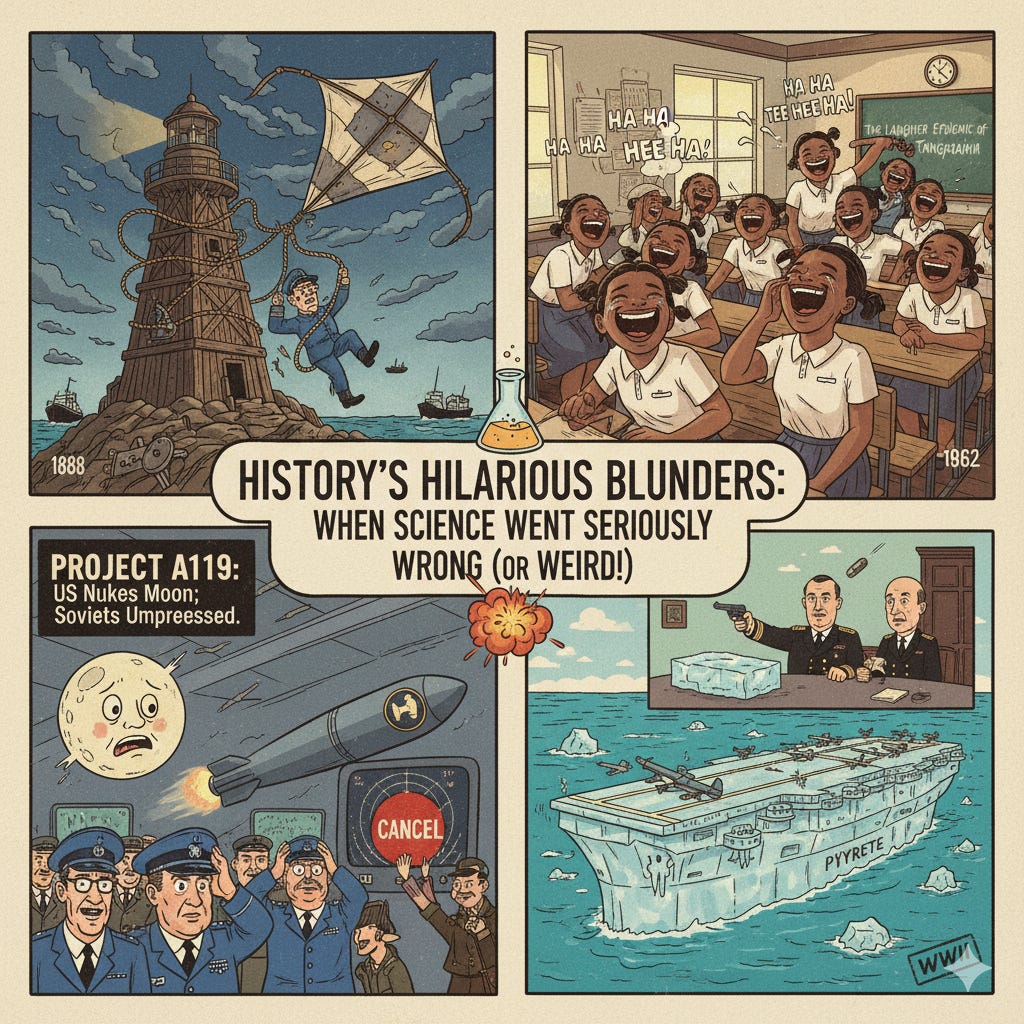
Imagine a powerful lighthouse, its beam cutting through the darkest storms, guiding ships safely to shore. Now imagine that lighthouse powered by… a giant kite. Yes, you read that right. In 1888, the Tasmanian government, eager to cut costs, commissioned a lighthouse to be powered by a massive kite. The theory was sound (ish): the kite would catch the wind, generate electricity, and illuminate the beacon. The reality? The kite, predictably, was a nightmare. It kept crashing, getting tangled, and generally refusing to cooperate. Ships still ran aground, and the project was eventually abandoned, leaving behind a legacy of flapping futility.

2. The Laughter Epidemic of Tanganyika (1962)

Sometimes, experiments aren’t conducted in labs, but in the crucible of everyday life. In 1962, a seemingly innocuous incident at a boarding school for girls in Tanganyika (now Tanzania) spiraled into one of the most bizarre psychological phenomena on record: a mass laughter epidemic. It started with three girls, but soon, uncontrollable fits of laughter, sometimes lasting hours, spread like wildfire through the school, forcing its closure. It then spread to surrounding villages, affecting thousands. While not a “failed experiment” in the traditional sense, it’s a fascinating and humorous (for us, perhaps less so for those afflicted) case study in mass hysteria and the power of the mind.

3. Project A119: The Moon Bomb (1950s)

During the Cold War, the US Air Force concocted a plan so audacious, so utterly bonkers, it almost defies belief: detonate a nuclear bomb on the moon. The goal? To demonstrate America’s military superiority and intimidate the Soviet Union. Thankfully, cooler heads (eventually) prevailed, and the project was scrapped due to concerns about fallout, the potential for a catastrophic misfire, and let’s face it, the sheer absurdity of it all. Imagine the headlines: “US Nukes Moon; Soviets Unimpressed.” A truly spectacular failure averted.

4. The Bridge That Wobbled: Tacoma Narrows Bridge (1940)

While not a “funny” experiment, the collapse of the Tacoma Narrows Bridge, affectionately dubbed “Galloping Gertie,” is a classic example of unexpected scientific failure. Just four months after its opening, the bridge began to oscillate wildly in relatively moderate winds, leading to its dramatic and mesmerizing collapse
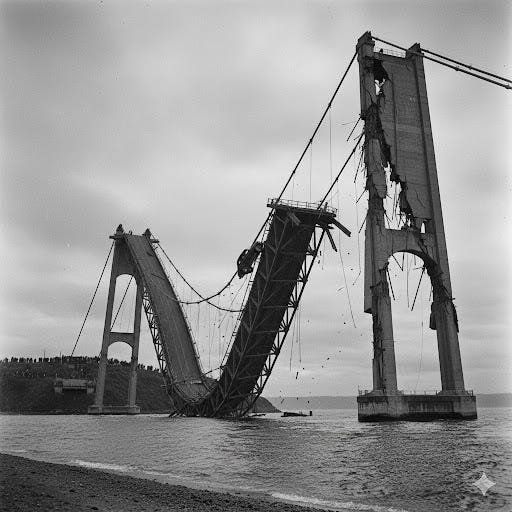
 

The event became a textbook case in engineering, teaching invaluable lessons about aerodynamics and resonance. It’s a sobering reminder that even with the best intentions, nature sometimes has other plans.

5. The Pykrete Aircraft Carrier (WWII)

During World War II, with steel in short supply, a brilliant (or utterly mad, depending on your perspective) idea emerged: build an aircraft carrier out of ice! Not just any ice, but “Pykrete,” a super-strong composite of ice and wood pulp. The idea was championed by Lord Mountbatten, who even brought a block of Pykrete into a meeting and fired a pistol at it to demonstrate its resilience (the bullet ricocheted, narrowly missing a general!). While a prototype was built and proved surprisingly robust, the practicalities of building and maintaining a colossal ice ship in warm waters proved insurmountable. The project was eventually melted down, so to speak.

Learning from the Lapses

These examples, from the absurd to the almost tragic, highlight an important truth about scientific progress: failure is an integral part of the process. While some of these experiments were genuinely funny in their execution, others offered crucial lessons, preventing future mistakes and pushing the boundaries of knowledge. So, next time you hear about a scientific breakthrough, spare a thought for the countless bizarre and brilliant failures that paved the way. After all, sometimes you have to build a kite-powered lighthouse or consider bombing the moon before you truly understand what not to do

Comments

Popular posts from this blog

A Land of Extremes: Where Mediterranean Breezes Meet the Roar of the Sahara – Discovering Algeria's Duality

  Imagine a country where you can wake up to the gentle lapping of Mediterranean waves, drive for a few hours through lush green mountains, and by sunset, be gazing at endless, towering sand dunes. This isn't a fantasy; this is Algeria. Africa's largest nation is a breathtaking "land of extremes," a geographical masterpiece defined by a stark, yet beautiful, duality. At its heart lies the incredible contrast between its vibrant, life-filled northern coast – the Tell – and the colossal, awe-inspiring expanse of the Sahara Desert. This fundamental split shapes everything: its climate, culture, history, and the very soul of the Algerian people. The Allure of the Tell: Algeria's Mediterranean Heartbeat Stretching along approximately 1,200 kilometers (745 miles) of coastline, the Tell Atlas region is where over 90% of Algeria's population resides. This narrow strip is a quintessential Mediterranean landscape, boasting: Lush Greenery: Contrary to desert stereotype...

✨ The Unseen Forces: Unveiling Light, Heat, Sound, and Energy Sources

  Our world is a symphony of invisible forces and phenomena that shape every moment of our existence. From the light that illuminates our path to the heat that keeps us warm, the sounds that fill our ears, and the energy that powers our lives, these concepts are fundamental to understanding the universe. Let's explore some fascinating facts about light, heat, sound, and the diverse sources of energy that drive it all! 💡 Light: The Universe's Messenger Light is more than just what helps us see; it's a fundamental particle and wave that carries information across vast cosmic distances. Dual Nature: Light is famously a paradox – it behaves as both a wave (like ripples on water) and a particle (called a photon). This wave-particle duality is a cornerstone of quantum mechanics! The Ultimate Speed Limit: The speed of light in a vacuum (approximately 299,792,458 meters per second or 186,282 miles per second) is the fastest anything in the universe can travel. If you could trav...

Law & Lore: 6 Wacky & Wonderful Facts About Global Laws and Customs

  From the seemingly mundane to the utterly bizarre, the rules and traditions that govern our lives vary wildly across the globe. What's perfectly normal in one country might be illegal or highly offensive in another. Exploring these unique laws and customs isn't just fun; it's a fascinating peek into the diverse values, histories, and quirks of human societies. Prepare to be surprised, amused, and perhaps a little perplexed as we delve into six mind-blowing facts about surprising laws and customs from around the world! 1. In Singapore, Chewing Gum is Seriously Regulated A seemingly harmless habit in many places can land you in serious trouble in this impeccably clean city-state. The Mind-Blowing Fact: Since 1992, chewing gum has been largely banned in Singapore . While the outright ban was slightly relaxed in 2004 to allow therapeutic, dental, or nicotine gum with a prescription, the sale and import of regular chewing gum remain illegal. This strict law was implemented to...