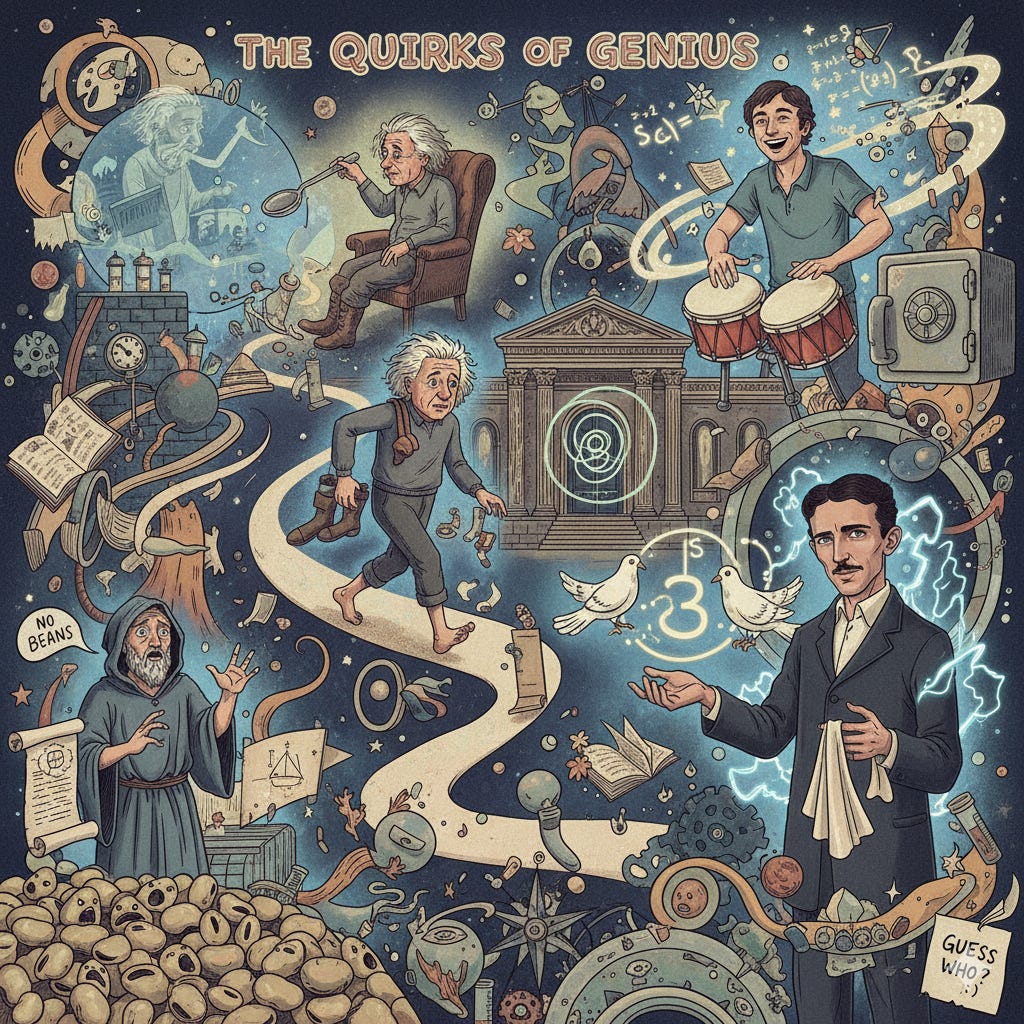
Ever wonder what a genius does when they’re not rewriting the laws of physics or cataloging the natural world? The truth is, many of history’s greatest scientific minds had routines and habits that were, well, a little weird. Far from dry, disciplined automatons, these brilliant thinkers often embraced eccentricities that may have actually fueled their revolutionary insights.
The Genius Who Hated Socks: Albert Einstein
When you picture Albert Einstein, you probably see a cloud of wild hair. But his disregard for conventional attire extended all the way down to his ankles—he notoriously never wore socks. He reportedly declared the sock a pointless distraction and, to hide his bare feet on more formal occasions, he’d opt for high boots.
But Einstein’s quirks weren’t all about fashion:
The Spoon Nap: To prevent deep sleep inertia, Einstein had a peculiar napping technique. He would sit in his armchair, holding a metal spoon over a metal plate. As he drifted off, the spoon would clatter to the plate, waking him just enough to feel refreshed without entering a deep sleep state.
A Love for Laps: Like Charles Darwin, Einstein was an avid walker. He considered his daily long walks essential, believing they helped clear his mind and aid his complex problem-solving.
The Obsessive Inventor: Nikola Tesla
The master of alternating current, Nikola Tesla, was a brilliant innovator whose life was governed by a strict set of routines and obsessions, suggesting a possible case of obsessive-compulsive disorder (OCD).
The Power of Three: Tesla was famously fixated on the number three. He insisted on staying in hotel rooms with numbers divisible by three and would often circle a building three times before entering.
18 Napkins: At every meal, he would use exactly 18 napkins to meticulously clean his silverware and utensils until they were spotless, demonstrating his severe aversion to germs.
The Pigeon Keeper: Late in his life, he developed an intense devotion to the pigeons of New York City, particularly a special white bird he claimed to have a deep connection with.
The No-Bean Rule: Pythagoras
Long before modern science, the Greek philosopher and mathematician Pythagoras—of the famous theorem—had one of the strangest prohibitions of all: no beans.
His followers, the Pythagoreans, followed a strict vegetarian lifestyle, but beans (specifically fava beans) were absolutely forbidden. Some theories suggest he believed they contained the souls of the dead, while others say he simply saw them as a cause of flatulence that disturbed the universe’s harmony. Legend even holds that he chose to die at the hands of pursuers rather than cross a bean field to escape.
The Bongo-Playing Physicist: Richard Feynman
Nobel laureate Richard Feynman, a key figure in quantum mechanics, was celebrated for his playful, unconventional nature.
Lockpicking: When working on the Manhattan Project in Los Alamos, he amused himself by picking the locks on filing cabinets and safes, leaving playful notes to prove how vulnerable the top-secret documents were.
The Drummer: He was an accomplished bongo drum player and would often use percussion to clear his mind and approach physics problems from a completely different angle.
These peculiar rituals remind us that genius doesn’t follow a one-size-fits-all model. Often, the path to a breakthrough is paved with individual quirks and unconventional habits. So the next time you feel a bit eccentric, remember you’re in good company!
Comments
Post a Comment