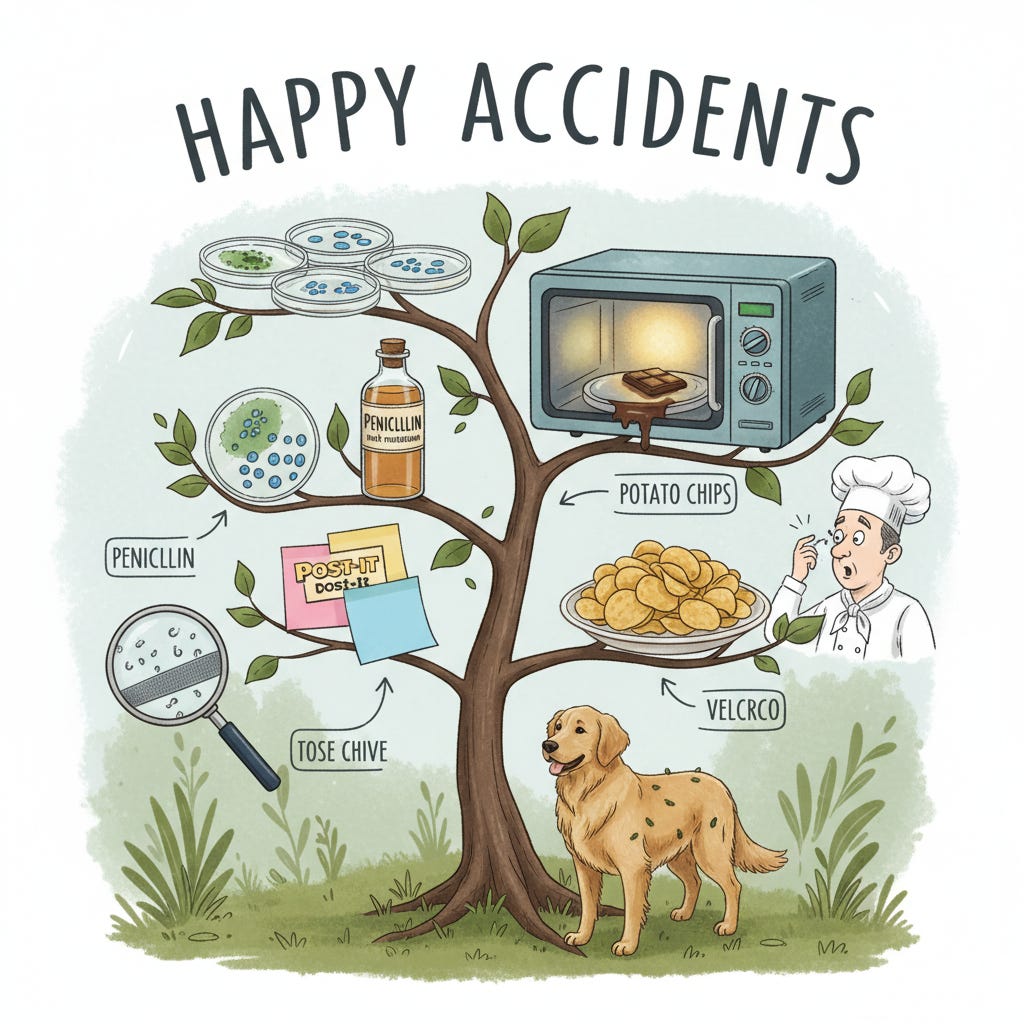
Sometimes, the greatest discoveries aren’t born from meticulous planning, but from a fortunate blunder. History is filled with incredible inventions that came about not by design, but by a surprising twist of fate. These “happy accidents” remind us that sometimes, the best way to innovate is to simply… mess up!
Here are a few of our favorite accidental inventions that changed the world:
1. Penicillin: The Moldy Miracle
It’s hard to imagine a world without antibiotics, and we owe their existence to a bit of forgetfulness. In 1928, bacteriologist Alexander Fleming returned to his lab after a vacation to find a petri dish contaminated with a fuzzy mold. Instead of tossing it, he noticed something peculiar: the mold seemed to be preventing the growth of his Staphylococcus bacteria. That mold, Penicillium notatum, was the source of penicillin, a discovery that revolutionized medicine and saved countless lives.
2. Post-it Notes: The “Weak” Adhesive That Stuck Around
What do you get when a scientist trying to create super-strong glue accidentally invents a weak adhesive? A brilliant idea for office supplies, of course! In 1968, Spencer Silver at 3M developed a “low-tack,” reusable adhesive. It was considered a failure for its original purpose, but years later, his colleague Art Fry used it to bookmark pages in his hymn book. The rest, as they say, is history, and the iconic Post-it Note was born, making our lives a little more organized and colorful.
3. Potato Chips: A Chef’s Salty Revenge
The crispy, salty snack we all love owes its existence to a very particular customer and a very annoyed chef. In 1853, at Moon’s Lake House in Saratoga Springs, New York, a diner repeatedly sent back his fried potatoes, complaining they were too thick. Chef George Crum, in a fit of pique, decided to slice the potatoes as thinly as possible, fry them to a crisp, and douse them in salt. To his surprise, the customer loved them, and the “Saratoga Chips” became an instant hit, eventually evolving into the potato chips we know today.
4. Microwaves: The Melting Chocolate Bar
Next time you’re reheating leftovers, thank a melting chocolate bar! In 1945, Percy Spencer, an engineer at Raytheon, was working on a magnetron for radar equipment. While standing near an active radar set, he noticed a chocolate bar in his pocket had melted. Intrigued, he experimented with other foods, leading to the development of the microwave oven. From a melted treat to a kitchen staple, talk about a sweet discovery!
5. Velcro: The Burrs That Inspired a Fastener
A walk in the woods with his dog led Swiss engineer George de Mestral to a sticky situation – and a brilliant idea. In 1941, he noticed how burrs clung tenaciously to his dog’s fur and his own clothes. Under a microscope, he saw tiny hooks on the burrs that latched onto loops in the fabric. This observation inspired him to create a two-sided fastener system with hooks and loops, which he named Velcro (a portmanteau of “velvet” and “crochet”). It quickly found applications everywhere, from clothing to space travel.
These stories are a fantastic reminder that innovation isn’t always a straight line. Sometimes, the most unexpected detours lead to the most groundbreaking destinations. So, next time you make a mistake, who knows? You might just be on the verge of the next big thing!
What are some other accidental inventions you find fascinating? Share them in the comments below!
Comments
Post a Comment