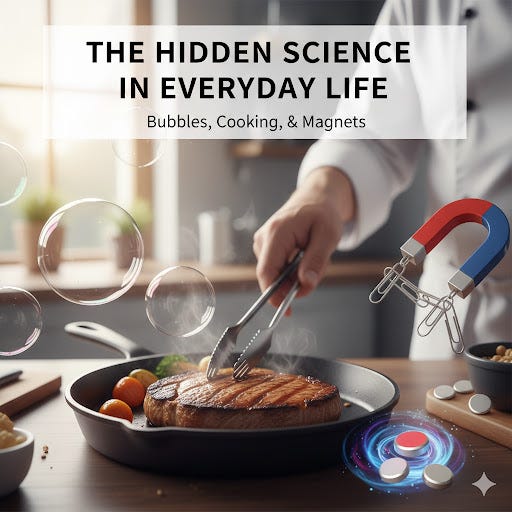
Ever stop to wonder about the little miracles happening all around you? The simplest things, from a glistening soap bubble to the perfect sear on a steak, are governed by fascinating principles of physics and chemistry. Let’s dive into the science behind a few common phenomena!
🌈 The Beautiful Physics of Soap Bubbles
A soap bubble looks simple, but it’s a tiny, elegant fortress of fluid dynamics.
The Soap Sandwich: A bubble is a thin film composed of two layers of soap molecules with a layer of water trapped in between—like a water sandwich with soap for the “bread.”
Surface Tension’s Role: Water molecules are polar (they have a positive and a negative end, similar to tiny magnets), which makes them strongly attract each other. This attraction creates surface tension, the force that makes water try to pull itself into the smallest possible shape (a sphere). However, pure water’s surface tension is too strong to form a stable bubble that can stretch.
The Surfactant Secret: This is where the soap, or surfactant, comes in. Soap molecules have one end that loves water (hydrophilic) and one end that hates water but loves air or oil (hydrophobic). They line up on the inner and outer surfaces of the water film, breaking down the water’s excessive surface tension and allowing the film to become flexible and stretchy—like a liquid balloon.
Why Are They Spherical? The perfect spherical shape is simply the most efficient geometric configuration. A sphere encloses the maximum volume of air with the minimum possible surface area, which is what the surface tension is constantly striving for.
Why the Colors? The swirling colors are due to light interference. The soap film is incredibly thin—comparable to the wavelength of visible light. Light reflecting off the outer soap layer interferes with light reflecting off the inner soap layer. Depending on the film’s thickness at any point (which is constantly changing as water drains), different wavelengths (colors) of light are either amplified or canceled out, creating the beautiful, shimmering rainbow effect.
🍳 The Chemistry of Cooking
From baking bread to frying an egg, your kitchen is a vibrant, edible chemistry lab.
The Maillard Reaction: When you brown toast, sear meat, or roast vegetables, you’re observing the Maillard reaction. This is a complex series of chemical reactions between amino acids (from proteins) and reducing sugars when heated. It creates hundreds of different flavor compounds and that desirable golden-brown color and irresistible aroma.
Caramelization: This process is similar to the Maillard reaction but only involves sugars. When sugars are heated to a high temperature, their molecular structure breaks down, forming new compounds that create the familiar rich, nutty, and slightly bitter flavors of caramel.
Emulsions: Many sauces and dressings, like mayonnaise or vinaigrette, are emulsions. This is a stable mixture of two liquids that normally don’t mix, such as oil and water. An emulsifier (like the lecithin in an egg yolk) acts as a mediator, with one end clinging to the oil and the other to the water, holding them together in a smooth, stable suspension.
🧲 The Invisible Force of Magnets
Magnets are magical, but their power comes from a subatomic level.
Electron Spin: Magnetism originates with the tiny particles inside atoms—the electrons. Electrons behave as if they are spinning, and this spin creates a tiny magnetic field.
Magnetic Domains: In most materials, these electron spins are randomly oriented, and their magnetic fields cancel each other out. However, in ferromagnetic materials (like iron, nickel, and cobalt), the magnetic fields of neighboring atoms align in small clusters called domains.
Making a Magnet: When a ferromagnetic material is not magnetized, these domains point in random directions. When you expose it to a strong external magnetic field (or rub it with a permanent magnet), all the domains in the material align in the same direction. This alignment creates a net magnetic field, and the material becomes a magnet with a distinct North and South pole.
The world isn’t just full of interesting things—it’s full of fascinating science waiting to be discovered. The next time you see a bubble, cook a meal, or pick up a magnet, remember the incredible forces and reactions at play!
Comments
Post a Comment