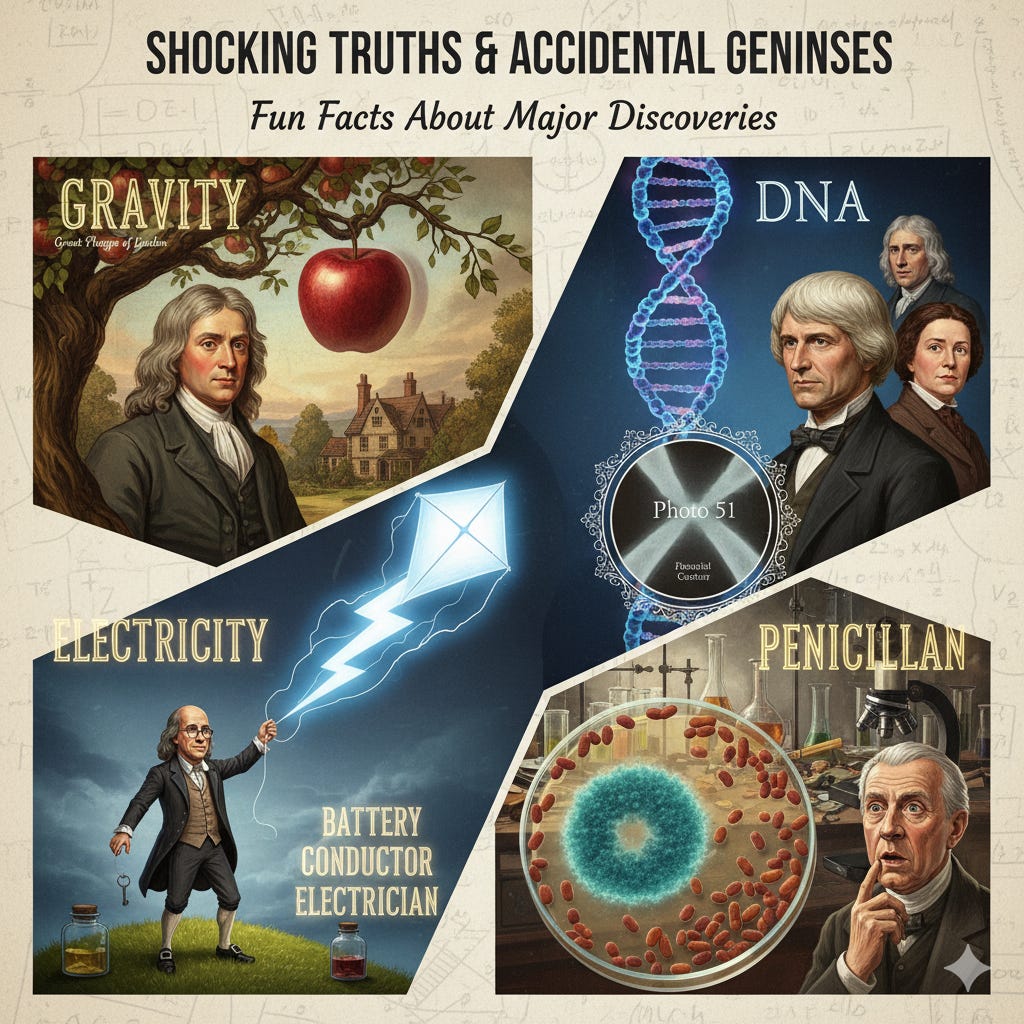
The history of science isn’t just a dry list of dates and equations; it’s filled with moments of sheer brilliance, happy accidents, and sometimes, a little bit of drama. Dive into some surprising fun facts about the major discoveries that shaped our world!
🍎 Gravity: Not Just an Apple’s Story
We all know the story: Sir Isaac Newton sits under an apple tree, an apple falls, and voilà, the law of universal gravitation is born. While the core idea is true, here’s the fun twist:
The Apple Didn’t Hit Him: While the inspiration came from watching an apple fall, the persistent rumor that it bonked him on the head is likely an embellishment. Newton himself recounted that the sight of the falling apple simply made him ponder why it fell straight down instead of sideways or up, leading to the breakthrough.
A “Plague” of Genius: Newton developed the foundations of his theories on gravity and calculus during the Great Plague of London (1665-1666). Forced to leave Cambridge, he retreated to his family home in Woolsthorpe, a period he later called his most creatively productive.
🧬 DNA: The Double Helix Drama
The discovery of the structure of DNA—the famous double helix—is one of the most important moments in modern biology, but the journey was a bit messy.
Rosalind Franklin’s Crucial Photo: The famous “Photo 51,” an X-ray diffraction image of DNA taken by Rosalind Franklin and her graduate student, Raymond Gosling, was absolutely critical. This image provided the clear evidence that James Watson and Francis Crick needed to deduce the helical structure. Tragically, Franklin’s vital contribution was initially underappreciated and she passed away before the Nobel Prize was awarded.
The Model was Built on Borrowed Data: Watson and Crick were shown Photo 51 without Franklin’s direct permission. This is one of the most contentious episodes in science history, highlighting the struggle for recognition in groundbreaking research.
⚡ Electricity: The Shocking Truth of the Kite
When you think of the discovery of electricity, you probably picture Benjamin Franklin and his famous kite experiment. But did you know this?
He Might Not Have Done It! While Franklin described the experiment and claimed he performed it in June 1752, some historians debate whether he actually carried out the full, life-threatening demonstration. The first person who definitely performed the experiment à la Franklin (safely, on the ground) and provided the first conclusive proof was French scientist Thomas-François Dalibard, based on Franklin’s instructions.
Franklin Coined the Terms: Whether he flew the kite or not, Franklin made huge contributions to our understanding of electrical charge. He introduced key terms we still use today, like “battery,” “conductor,” “charge,” and “electrician,” giving structure to the entire field.
🧪 Penicillin: The Fortuitous Fungus
The discovery of penicillin by Alexander Fleming revolutionized medicine and saved millions of lives, all thanks to a little bit of sloppiness.
The Unkempt Lab: Fleming was known to be a somewhat untidy scientist. In 1928, he left a petri dish containing Staphylococcus bacteria uncovered near an open window while on vacation. When he returned, he noticed a mold (Penicillium notatum) had contaminated the dish, and, crucially, the bacteria failed to grow around the mold!
“A Thoughtless Act”: Fleming initially described the discovery as having been made because of a “thoughtless act” (leaving the dish uncovered). His initial work didn’t lead to the mass-produced medicine we know today; that was achieved later by Howard Florey and Ernst Chain, who purified and stabilized the drug.
These incredible breakthroughs prove that the greatest discoveries are often born from a combination of focused genius, intense curiosity, and sometimes, pure, wonderful luck!
Comments
Post a Comment