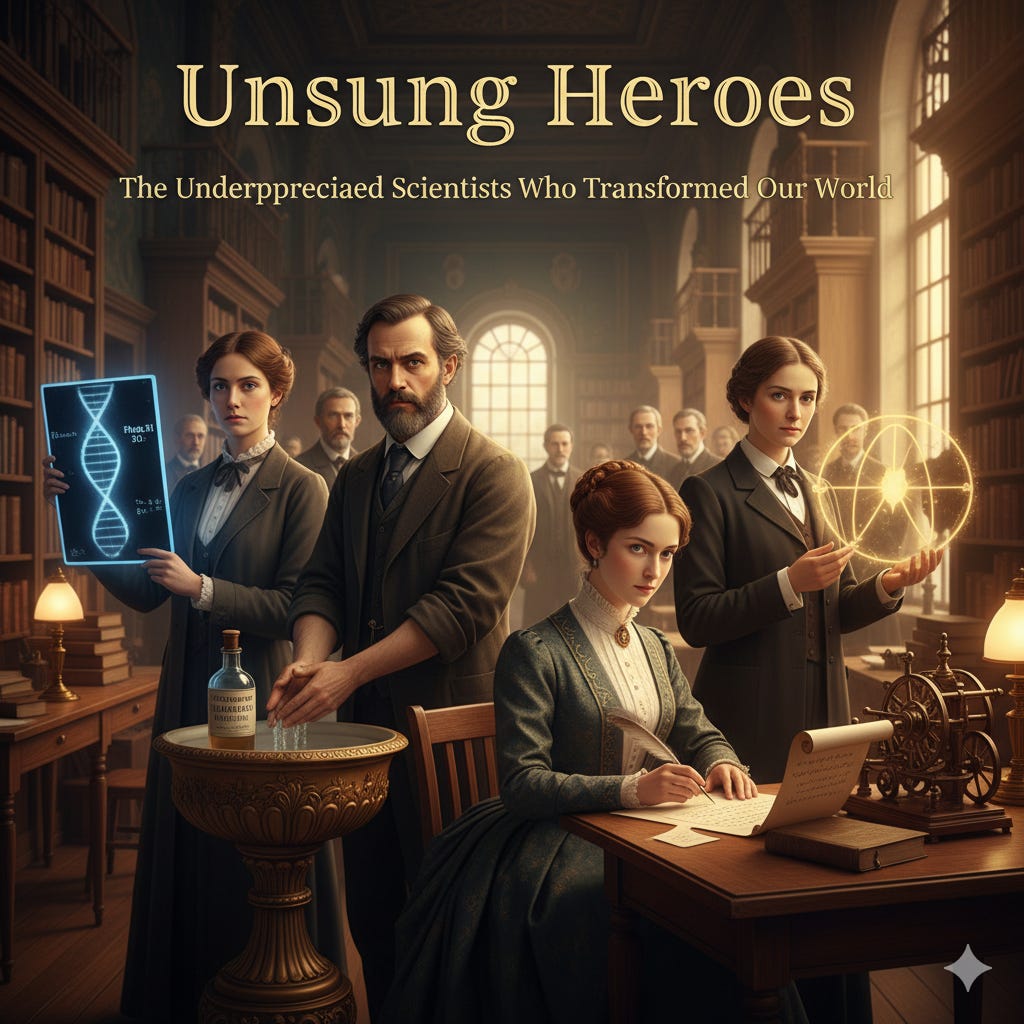
When we think of scientific titans, names like Einstein, Newton, and Curie immediately spring to mind. Their impact is undeniable, but the history of science is also filled with brilliant minds whose groundbreaking work laid the foundation for modern life, yet who rarely receive the recognition they deserve.
Let’s shine a light on some of the most underappreciated scientists who truly changed the world.
💡 Rosalind Franklin: The Uncredited Architect of DNA
Perhaps one of the most glaring examples of a scientist whose contribution was overlooked is Rosalind Franklin. Her meticulous X-ray diffraction images of DNA, particularly the famous “Photo 51” , were absolutely critical in determining the double-helix structure of DNA.
Her Role: She produced the clearest images showing the helical structure and repeating units of the DNA molecule.
The Outcome: James Watson and Francis Crick, who received the Nobel Prize for the discovery, directly relied on her data (which was shown to them without her permission) to formulate their famous model.
The Injustice: Franklin died before the Nobel Prize was awarded in 1962 and thus was ineligible, but her pivotal role was often minimized or ignored in the subsequent years. Without her experimental evidence, the discovery of the double helix would have been significantly delayed.
🌡️ Ignaz Semmelweis: The Handwashing Champion
In the mid-19th century, hospitals were places of both healing and, often, death. The rate of puerperal fever (childbed fever) was tragically high in maternity wards. Ignaz Semmelweis, a Hungarian physician, noticed a stark difference in mortality rates between wards attended by doctors/medical students and those attended by midwives.
His Discovery: He hypothesized that “cadaverous particles” from autopsies (which the doctors performed before attending to patients) were being transferred to the mothers.
His Solution: Semmelweis mandated that doctors and medical students wash their hands with a chlorinated lime solution before examining patients.
The Impact: The mortality rate in his ward plummeted from as high as 18% to under 2%.
The Sad Irony: His colleagues, offended by the suggestion that they were causing their patients’ deaths, rejected his simple, life-saving findings. He was ridiculed and eventually driven to a nervous breakdown. It took decades for hand hygiene to become standard medical practice, costing countless lives in the interim.
💻 Ada Lovelace: The World’s First Computer Programmer
Long before the invention of the electronic computer, English mathematician Ada Lovelace saw the revolutionary potential in Charles Babbage’s conceptual mechanical general-purpose computer, the Analytical Engine.
Her Vision: While Babbage saw the machine primarily as a calculator, Lovelace understood it could process symbols and follow rules far beyond mere number crunching.
Her Contribution: She wrote what is widely regarded as the first algorithm intended to be carried out by a machine, an elaborate plan for the Analytical Engine to compute a sequence of Bernoulli numbers.
Her Legacy: This work is considered the world’s first computer program, making Ada Lovelace the prophetess and pioneer of modern computing. Today, her legacy is celebrated, but for a long time, her foundational contribution was eclipsed by her male contemporaries.
🔬 Lise Meitner: The Mother of Nuclear Fission
Austrian physicist Lise Meitner was a crucial figure in the discovery of nuclear fission. For decades, she worked closely with chemist Otto Hahn.
The Breakthrough: After fleeing Nazi Germany, Meitner corresponded with Hahn, who had conducted an experiment that seemed inexplicable. Meitner and her nephew, Otto Frisch, were the first to correctly interpret Hahn’s results as the splitting of the atomic nucleus, coining the term “nuclear fission.” She even calculated the enormous energy released, using Einstein’s famous equation, $E = mc^2$.
The Disappointment: Otto Hahn alone received the 1944 Nobel Prize in Chemistry for the discovery. Despite her foundational theoretical work, Meitner was tragically overlooked by the Nobel Committee.
These stories remind us that science is a collaborative and often messy human endeavor. While we celebrate the giants, let’s also reserve a place of honor for the unsung heroes—those whose perseverance, insight, and sacrifice laid the crucial groundwork for the technological and medical marvels we enjoy today. Their names deserve to be as familiar as any other.
Who is another underappreciated scientist you think deserves more credit? Share your thoughts below!
Comments
Post a Comment